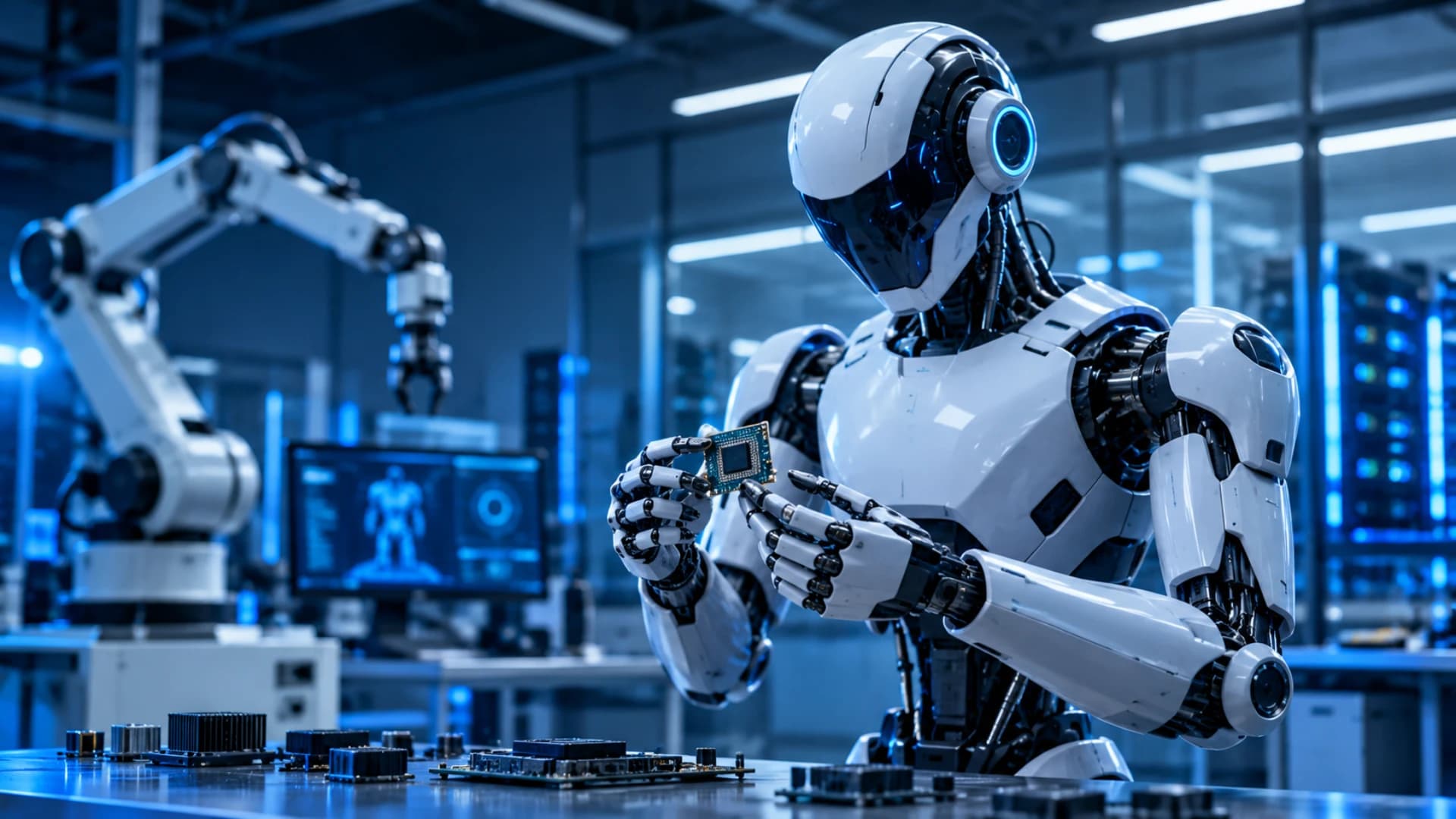
A new humanoid robot platform unveiled by Agile Robots and NVIDIA aims to simplify one of the biggest challenges in robotics: turning an experimental machine into a robot that developers can train, test and deploy. Announced at NVIDIA's GTC Berlin event on October 21, 2026, Agile ONE SN combines a humanoid robot with AI computing, robot-learning software and development workflows intended to reduce integration work. The platform is scheduled to become available in early 2027.
The announcement reflects a broader shift in the humanoid robotics industry. Building a robot is only part of the challenge; developers must also connect sensors, control systems, simulation software, training pipelines and AI models before a machine can perform useful physical tasks. Agile Robots and NVIDIA say their integrated approach can cut setup time from weeks to days, potentially helping research teams move from experimentation to real-world testing more quickly.
What is the Agile ONE SN humanoid platform?
Agile ONE SN is a full-stack humanoid reference platform developed by Agile Robots using NVIDIA's Isaac GR00T robotics technology and Jetson Thor onboard computing. A reference platform gives researchers and developers a starting point for building, testing and validating robot capabilities rather than requiring them to assemble every hardware and software component independently.
The robot is based on the Agile ONE S humanoid body. According to NVIDIA, it stands approximately 1.40 meters tall and weighs 40 kilograms, with 31 degrees of freedom and a payload capacity of 3 kilograms per arm. These specifications place it in the compact humanoid category, with a design intended for research into manipulation, movement and AI-controlled physical tasks.
The platform also features two WUJI Hand 2 five-finger hands. Each hand has 20 degrees of freedom, tactile sensing and force control operating at 1 kilohertz, according to NVIDIA. These capabilities are intended to support more precise interactions with objects, although real-world dexterity will depend on the task, object properties, control software and how well the AI system has been trained and validated.
NVIDIA computing powers the robot's AI
Agile ONE SN uses NVIDIA Jetson Thor for onboard AI processing. NVIDIA lists 128 gigabytes of unified memory and up to 2,070 FP4 teraflops of computing performance for the platform. The system is designed to support onboard reasoning and real-time robot control, reducing the need to treat the robot as a mechanical device controlled entirely by an external computer.
The robot's sensing equipment includes cameras mounted on the head and wrists, lidar sensors and inertial measurement units. Together, these sensors provide information about the surrounding environment, the robot's position and the objects it is interacting with. That information can help an AI system interpret a scene, plan movements and coordinate actions across the robot's body.
The platform is preconfigured with NVIDIA Isaac GR00T, a robotics foundation-model and development framework designed to support humanoid learning and control. NVIDIA also says the planned integration includes its Halos safety technology. The announcement describes this safety integration as planned, rather than confirming that every part of the final safety architecture is already complete or independently certified.
Why reducing setup time matters
Humanoid robotics teams often need to combine several separate tools before a robot can learn a new skill. They may need to build or collect training data, create a simulated environment, train a control policy, connect the resulting software to physical hardware and evaluate whether the robot can perform the task safely. Integrating these stages can consume considerable engineering time.
Agile ONE SN is designed to bring more of that process together. NVIDIA says the integrated workflow can reduce setup from weeks to days, giving developers a more direct path from research to physical testing. The stated improvement is a company claim about the development workflow, not a guarantee that every new robot skill or deployment will be completed within a few days.
Faster setup could be valuable for universities, robotics laboratories and companies testing humanoids for industrial work. Teams could potentially spend less time connecting software components and more time evaluating tasks such as object handling, material movement and coordinated manipulation. The real benefit will depend on how much custom engineering each project still requires.
NVIDIA is expanding its wider robotics software ecosystem
The Agile ONE SN announcement came alongside a broader expansion of NVIDIA's Isaac robotics platform. NVIDIA introduced Isaac OS, an open-source runtime framework designed to connect AI, sensors, control systems and robot hardware. It also announced Isaac Lab 3.0, a robot-learning framework intended to help developers train and refine robot behaviors using simulation and computing resources ranging from desktop systems to data centers.
NVIDIA also highlighted a SimReady Central Library containing more than 2,000 simulation-ready robotics and factory assets, as well as the Human 1M Dataset, which includes human-activity data, synchronized video from three views and three-dimensional hand tracking. These resources are intended to help developers build virtual environments and generate or prepare data for training robotic systems.
Simulation can help developers test behaviors before running them on physical hardware, potentially reducing the number of expensive real-world experiments required. However, a robot that performs well in simulation may still encounter problems in the physical world because of friction, sensor noise, changing lighting, unexpected contact or differences between the simulated model and the real machine. Physical testing remains essential.
When will the humanoid platform be available?
NVIDIA says Agile ONE SN is scheduled to become available in early 2027. The platform is intended primarily to advance humanoid robotics research and development, and the announcement noted interest from institutions including Stanford University and ETH Zurich. The company has not established that the system is already broadly available for commercial purchase.
The announcement also does not mean that humanoid robots are ready to replace human workers across entire industries. A reference platform can make experimentation easier, but commercial deployment still requires reliable task performance, safe operation, maintenance, integration with existing systems and a clear economic advantage over alternative automation.
For industrial operators, the most important measures will be whether the robot can complete repetitive tasks consistently, work safely around people, handle variations in objects and environments, and operate at an acceptable cost. Developers will also need to evaluate the amount of human supervision required and how well a trained skill transfers to different conditions.
What Agile ONE SN means for humanoid robotics
The introduction of Agile ONE SN highlights an industry strategy that combines humanoid hardware with reusable AI models, simulation tools and standardized development workflows. Instead of treating every robot as a separate engineering project, companies are trying to create platforms that make it easier to build, train and validate physical AI systems.
If the integrated approach works as intended, researchers could test new skills more quickly and companies could evaluate humanoid applications with less initial setup work. But the platform's long-term impact will depend on actual availability, independent testing, task reliability and the effort required to move from a controlled demonstration to a production environment.
Agile ONE SN is therefore best viewed as a development platform rather than a finished answer to every challenge in humanoid robotics. Its planned 2027 availability will provide a clearer opportunity to evaluate whether combining hardware, AI computing and software workflows can meaningfully accelerate the path from laboratory research to useful robots.